The stages of lipedema
- Researched against current medical guidelines
- Every claim sourced & linked to a named authority
- Independent — we don’t sell surgery
- Not a substitute for your doctor.
Lipedema is grouped into stages by how the skin and tissue change — not by body size. Stage 1 has smooth skin with tiny nodules; Stage 2 adds dimpling and larger nodules; Stage 3 has large lobes of tissue. "Stage 4" means lymphedema has developed too. A 2025 study adds in-between stages 1.5 and 2.5.
On this page
- What are the stages of lipedema?
- Stage 1 — smooth skin, small nodules
- Stage 1.5 — early dimpling on part of the thigh
- Stage 2 — even dimpling, larger nodules
- Stage 2.5 — whole-thigh dimpling, lobes forming
- Stage 3 — large lobes, possible mobility impact
- What is "Stage 4" lipedema (lipo-lymphedema)?
- What are the new 1.5 and 2.5 stages?
- Does a higher stage mean worse symptoms?
- Want to know which stage fits you?
What are the stages of lipedema?
Lipedema staging describes changes to the skin surface and the texture of the underlying fat tissue. It does not describe body size — a slim person can be Stage 3 and a larger person can be Stage 1. Staging is a clinical tool to guide treatment decisions, not a measure of how "bad" your situation is.
The traditional three-stage system comes from the US Standard of Care (Herbst et al., 2021). Stages 1.5 and 2.5 were proposed by a 2025 staging study (Al-Ghadban, Herbst et al., Life) to capture the continuum of progression.
Stage 1 — smooth skin, small nodules

The skin surface is smooth — no visible dimpling or roughness. Underneath, the fat feels nodular: small, soft granules like pearls or grains of rice in a bag. The legs may already be noticeably disproportionate and tender, even though the skin looks normal from the outside.
Why Stage 1 is so often missed
Because the skin looks normal, Stage 1 is frequently dismissed as 'just your shape' or 'normal weight gain.' The nodular texture on palpation and the tenderness are what distinguish it — signs a clinician needs to feel for, not just look at.
Stage 1.5 — early dimpling on part of the thigh
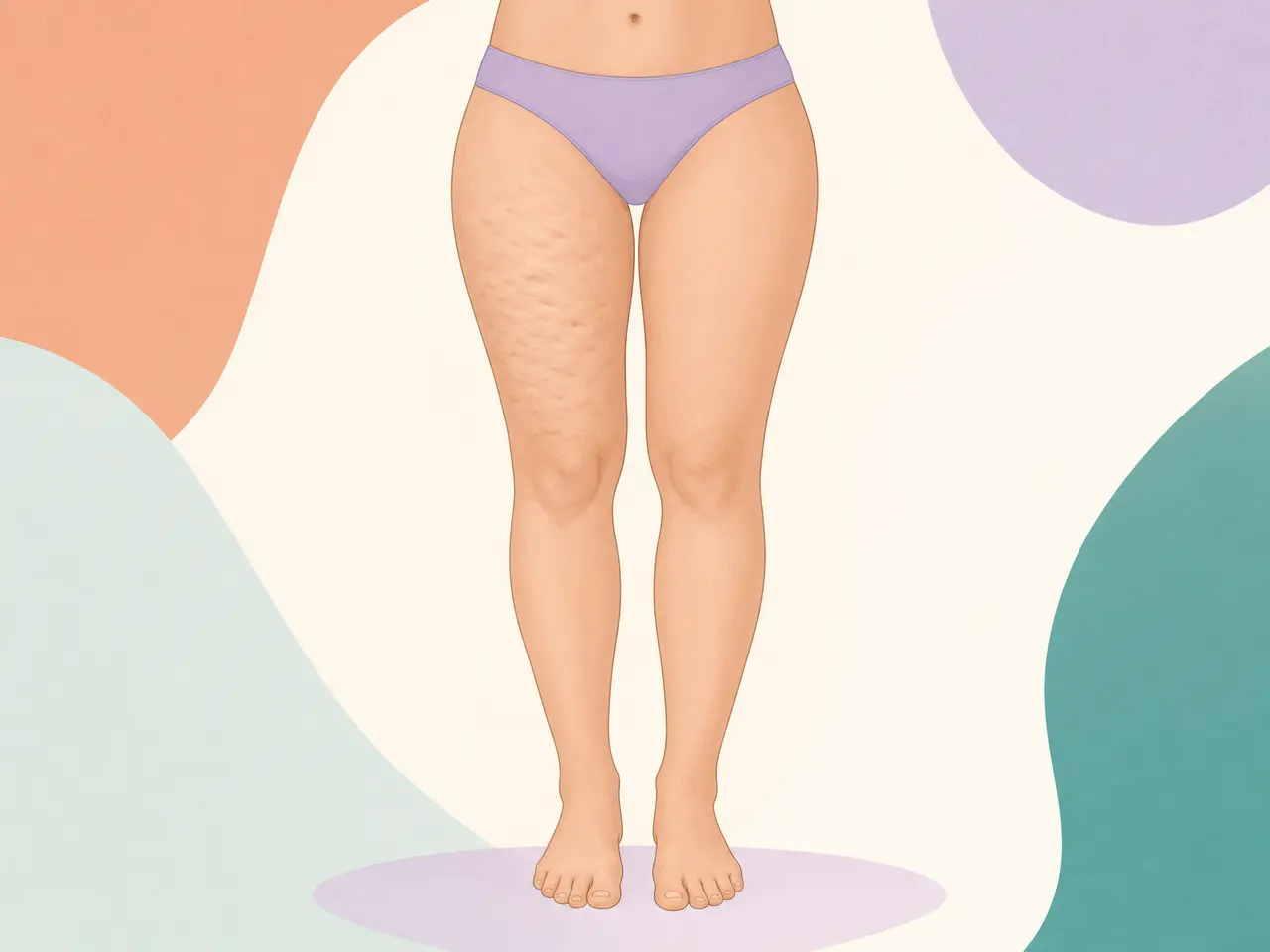
New intermediate stage (2025). Faint dimpling appears on part of the thigh — typically the outer surface — while other areas remain smooth. The nodules are still small and granular. This stage reflects the reality that the transition from Stage 1 to Stage 2 is gradual, not a sudden step.
About Stage 1.5 and 2.5
These intermediate stages were proposed in a 2025 research paper as a promising refinement to better capture where someone sits in the progression. They are under evaluation and not yet incorporated into formal clinical guidelines. Some clinicians use them; others still use the original 1–3 scale.
Stage 2 — even dimpling, larger nodules
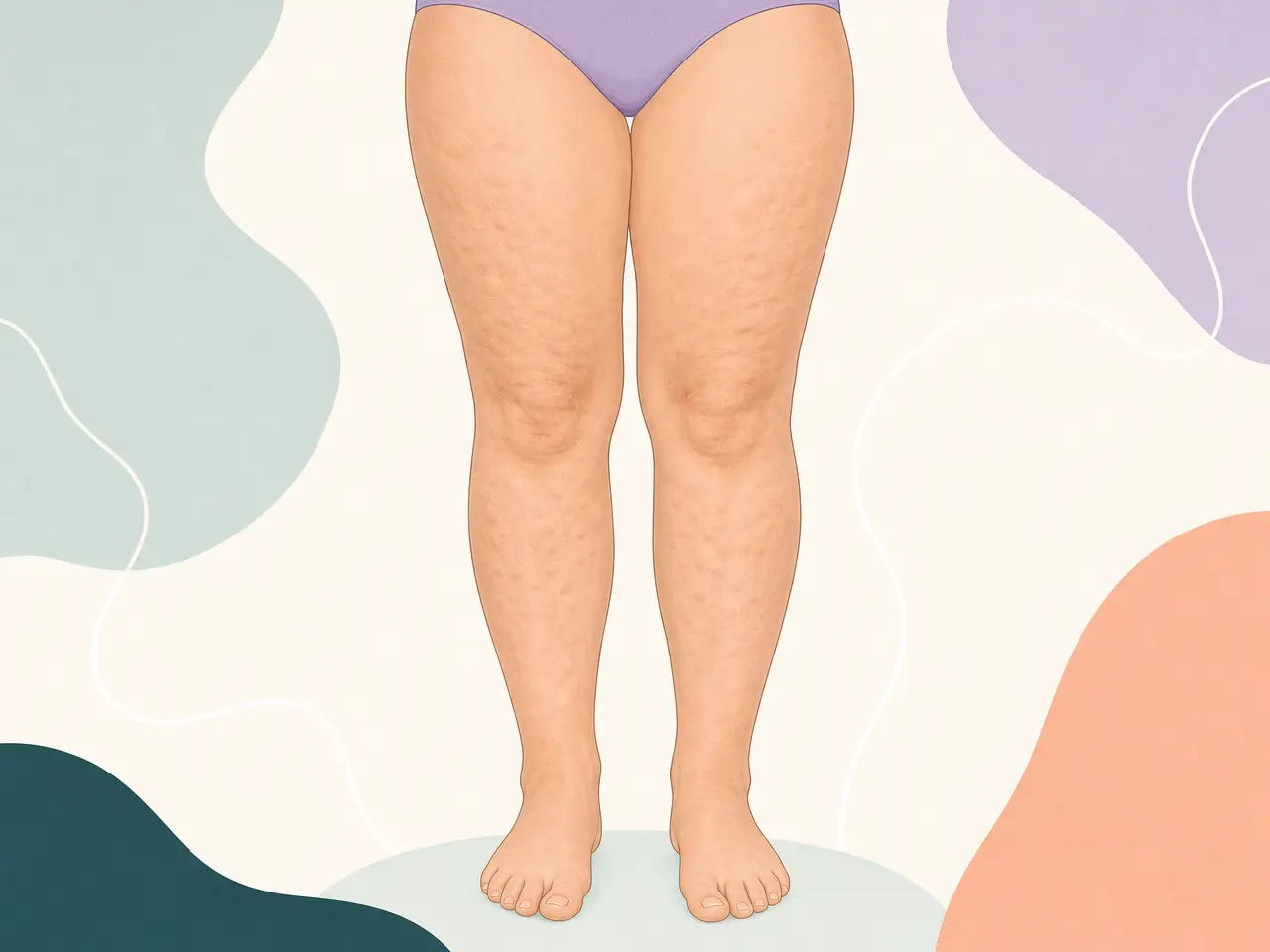
The skin surface develops an even, orange-peel or mattress-like dimpling across the affected area. The nodules grow larger — pea-to-walnut sized — and the tissue feels more fibrous and less uniformly soft. Tenderness and bruising typically continue. This is the stage at which lipedema becomes most visually obvious to clinicians who know what to look for.
Stage 2.5 — whole-thigh dimpling, lobes forming

New intermediate stage (2025). Dimpling now covers the whole thigh, and small lobes of tissue begin forming at the hip and inner knee. The transition from diffuse dimpling to distinct lobes marks this stage. Mobility may start to be subtly affected.
Stage 3 — large lobes, possible mobility impact
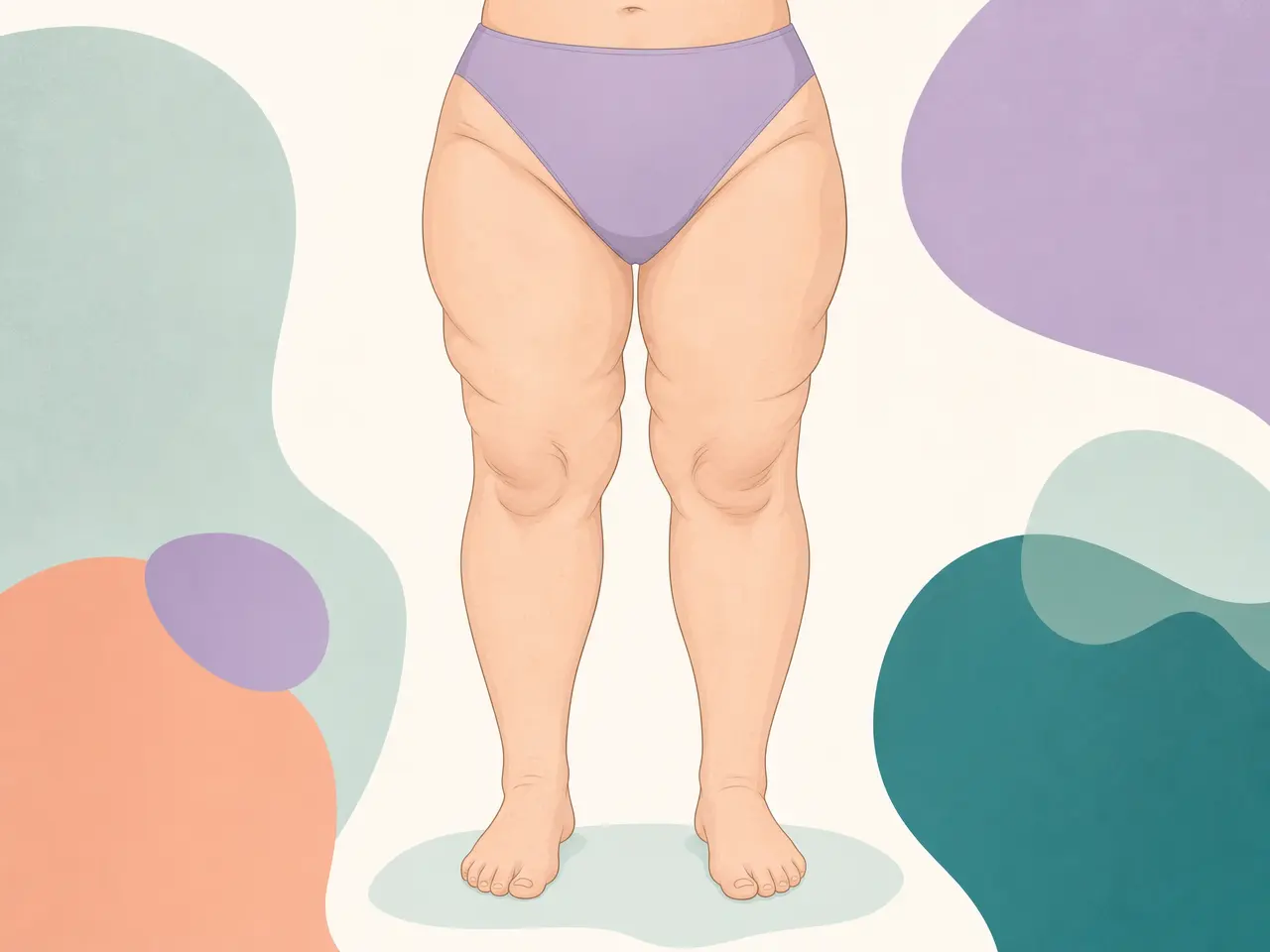
Large, soft lobes or overhangs of tissue form at the inner thighs, the knee area, and sometimes the lower legs. The overhangs can press on the knees and alter gait. The tissue is more fibrous. Many people at this stage describe significant day-to-day mobility impact and pain. Skin changes and increased susceptibility to lymphatic overload become more relevant.
What is "Stage 4" lipedema (lipo-lymphedema)?
"Stage 4" is not a separate tissue stage — it is best described as lipedema plus lymphedema occurring together (lipo-lymphedema). Long-standing lipedema can overload the lymphatic system, causing secondary lymphedema to develop. When this happens, swelling extends into the feet and toes (which are spared in pure lipedema), pitting edema may appear, and the Stemmer sign may become positive.
Lipo-lymphedema can develop at any stage
Lymphedema is not reserved for Stage 3 — it can layer on top of earlier stages, particularly with prolonged untreated lipedema or with additional risk factors (obesity, immobility, surgery). Early management matters.
What are the new 1.5 and 2.5 stages?
A 2025 study (Al-Ghadban, Herbst et al., Life) proposed intermediate stages 1.5 and 2.5 because lipedema progression is a continuum, not a series of sudden jumps. The traditional three-stage scale left many patients feeling "between" stages with no clear label.
Stage 1.5 captures early partial dimpling that has moved past pure Stage 1 but has not yet reached uniform Stage 2 dimpling. Stage 2.5 captures whole-thigh dimpling with early lobe formation, before the large lobes of Stage 3 are established. Both are promising refinements under evaluation, not yet in formal clinical guidelines.
Does a higher stage mean worse symptoms?
Not necessarily — and this matters a great deal. Pain, fatigue, and impact on daily life do not reliably track stage number. Some people at Stage 1 have severe daily pain; some at Stage 3 manage well with compression and exercise. Stage describes what the tissue looks and feels like, not how much it affects your life.
Stage does guide treatment — for example, Stage 3 with large lobes is more likely to benefit from surgery than Stage 1, and insurance decisions may be partly stage-dependent — but it does not dictate how seriously your symptoms should be taken. All stages deserve proper care.
Data from a 707-patient US survey (Aday et al., Vascular Medicine, 2024).
Want to know which stage fits you?
Our stage finder walks you through the skin and tissue signs and gives you a guide — useful as a starting point before a clinical appointment.
Sources
- Herbst KL et al. — US Standard of Care, Phlebology 2021 journals.sagepub.com
- Al-Ghadban, Herbst et al. — Lipedema Staging, Life 2025 pmc.ncbi.nlm.nih.gov
- Aday et al. — US Patient Survey, Vascular Medicine 2024 pmc.ncbi.nlm.nih.gov
- Delphi Consensus on Lipedema — Nature Communications 2026 nature.com